
Available in Audio Format:
Original article published Sep 23, 2025; updated on Sep 24, 2025 and Dec 12, 2025.
Each of Canada’s ten provinces practices gender medicine differently, as provinces have primary jurisdiction over health care. This gives each province the ability to adapt to new evidence more quickly and respond to the demands of its local citizens better than if health care were centralized with the federal government. But this also means that it is harder to understand all the nuances of each system and to collect data from across the country. Over the coming months, we will do our best to profile the data and policies on medical transitioning for minors in each province.
Our series is going to begin with Alberta.
Policy
Alberta is the lone province in the country that has taken the greatest steps to limit medical transitioning for minors. Prior to 2024, Alberta had no legal restrictions on the intervention, though “bottom” surgeries (e.g. penectomy, phalloplasty, vaginoplasty, orchiectomy) were rarely, if ever, performed on minors in practice. Pre-pubescent children received puberty blockers, and adolescents received cross-sex hormones and “top” surgeries without age restrictions.
That changed in late 2024 when the Alberta legislature passed Bill 26, the Health Statutes Amendment Act. The new law bans “puberty suppression,” “hormone replacement therapy,” and “sex reassignment surgery” to treat gender dysphoria or gender incongruence for any minor under the age of 18. (Eighteen is the age of majority in Alberta.) However, the law permits the Minister of Health to create exceptions for puberty blockers and cross-sex hormones through regulation. The government intends to use this clause to allow “minors aged 16 and 17 with parental, physician and psychologist approval” and “minors who have already been prescribed hormone replacement therapies to treat gender dysphoria or gender incongruence” to receive these pharmaceuticals.
Although the law passed the legislature, not all of these provisions banning medical transitioning are in force. In fact, only the ban on gender surgeries for those under 18 applies right now. The sections dealing with “hormone therapies” (i.e. puberty blockers and cross-sex hormones) will come into force upon Proclamation (when an order from Cabinet brings them into force). Ostensibly, the government is waiting to make this law legally binding until it has created the ministerial order that makes the exemption for 16- and 17-year-olds and minors already on puberty blockers or cross-sex hormones.
The bottom line? Alberta has banned surgical transitions for minors and set the stage to ban puberty blockers and cross-sex hormones for minors, but hasn’t implemented the full ban yet. Hormonal therapies for minors are still legal.
Providers
According to the Alberta Health Services’ hospital and facility directory, three main institutions in the province participate in pediatric gender medicine:
- University of Alberta Hospital’s The Gender Program in Edmonton – Stollery Children’s Transgender Clinic embedded within the University of Alberta Hospital
- Aberhart Centre’s Pediatric Endocrinology Clinic in Edmonton
But pediatric gender medicine is not just the purview of specialized gender clinics. It is increasingly being practiced by primary care providers, more commonly known as family doctors. Gender ideologues in medicine have taken up the slogan “gender-affirming care is primary care.” Another journal article opines that “because primary care providers often have in-depth understanding of their patients’ medical and mental health background and the greater context of their lives and support networks, they are well positioned to assess a patient’s readiness for gender-affirming hormone therapy and initiate treatment.”
According to one freedom of information request, the majority of physicians prescribing the hormones used in medical transition to minors are family physicians. Between 2019-2023, an average of 22 family physicians started minors on a medical transition each year, compared to an average of 10 pediatricians.
Prevalence
As we’ve mentioned before, it is challenging to find any data on the number of minors who are medically transitioning. The ideal dataset would list the entire number of minors currently prescribed puberty blockers or cross-sex hormones for the purpose of a gender transition, plus the number of “gender-affirming” top and bottom surgeries performed on minors. But there are several factors that make such data difficult to collect. First, so many players are involved in gender medicine – children’s hospitals, specialized gender clinics, and family doctors – that it is hard to collect all the data into one centralized spot. Every participant would have to report in order for the data to be complete. Second, because all of the medications prescribed for a gender transition are also used to treat other conditions (e.g. precocious puberty, breast or prostate cancer, menopause, or naturally low hormone levels), it is difficult to isolate just prescriptions for “gender-affirming care.” And finally, the involvement of both provincial drug programs and private insurance programs in funding “gender-affirming care” makes it difficult to track the money. Hence, governments don’t publish this data anywhere. In some cases, it doesn’t even seem like the government even has the information. They simply let the system of medical transitioning carry on.
The government of Alberta put it this way:
Currently, there is no data system within Alberta that tracks the number of children receiving gender care. While administrative health care data systems such as Morbidity and Ambulatory Care Abstract Reporting (MACAR), Supplemental Enhanced Service Event (SESE), and Pharmaceutical Information Network (PIN) provide some insights into aspects of gender care (breast surgeries, genital surgeries funded out-of-province, and hormone prescriptions) they do not directly capture the real figures for children receiving gender-related treatments. Consequently, the exact number of children in Alberta who are receiving gender care remains unknown.
Although comprehensive data is unavailable, health administrative records should have some information on the number of children and adolescents who are medically transitioning, and so we submitted several freedom of information requests to access any of the data that the government has.
One FOI request was for the number of patients seen at Alberta’s two main gender clinics at Alberta Children’s Hospital and Stollery Children’s Hospital between 2000-2025. The government released the following data.
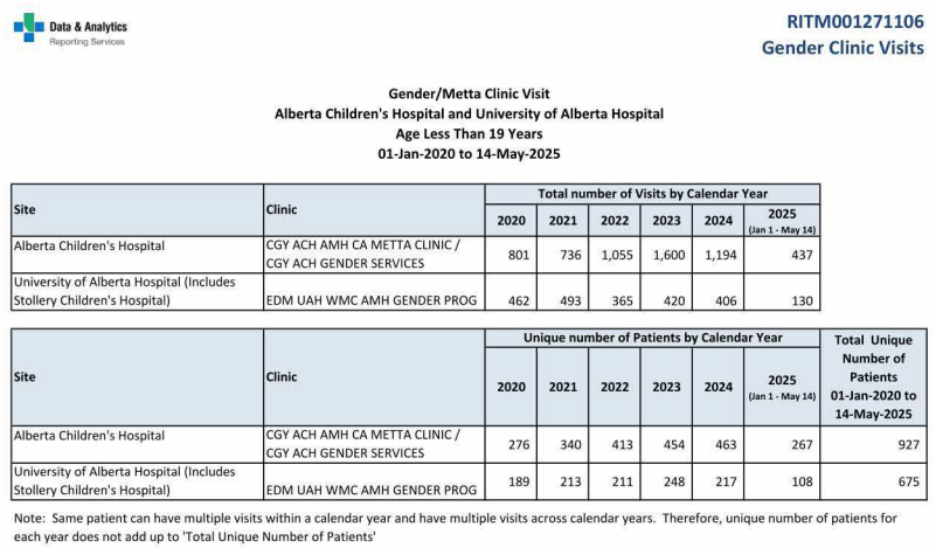
The first thing to note is that this data records the number of unique patients and total visits to these two gender clinics for whatever reason. Now, not all children struggling with their gender identity and visiting a gender clinic choose to medically transition. What this data does show is the number of children and adolescents struggling with gender dysphoria and considering – if not obtaining – a medical transition.
And these numbers have been growing over the past few years. The number of visits reached 2,020 in 2023, while the number of unique patients peaked at 702 in 2024.
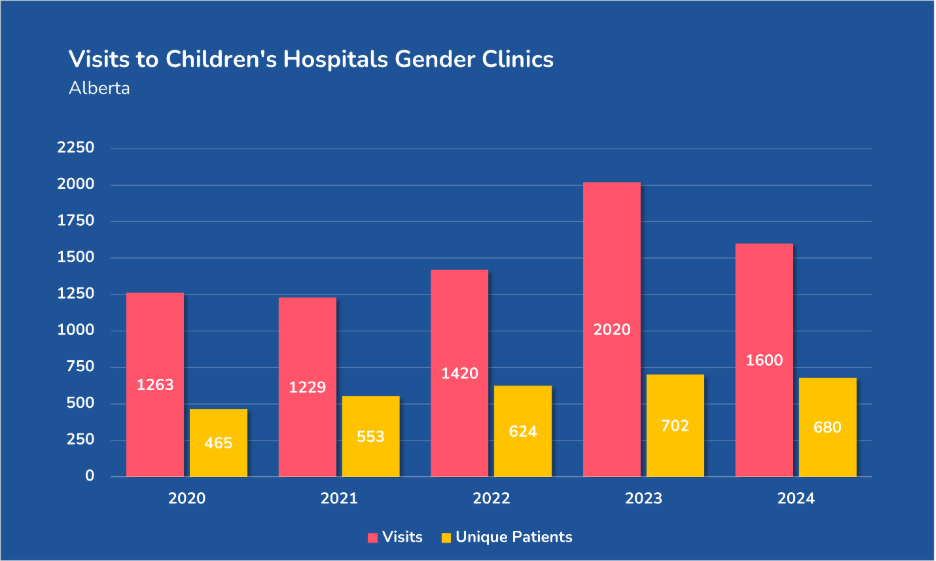
And this isn’t even everyone. It accounts for those visiting Alberta’s two largest pediatric gender clinics, but it doesn’t include those visiting the Aberhart Centre’s Pediatric Endocrinology Clinic or lesser-known pediatric gender clinics, nor those who received puberty blockers and cross-sex hormones from family doctors. What we can say with some certainty is that at least 1,600 minors have sought to medically transition in the last five and a half years in Alberta.
Another FOI sheds more light on the actual number of children hormonally transitioning. Taken from the Pharmaceutical Information Network (PIN), this data records the number of first pharmacy dispenses for gender care starts for persons aged 11-17. In other words, it tells us how many adolescents begin medically transitioning each year. It does not tell us cumulatively how many minors are medically transitioning in a given year.
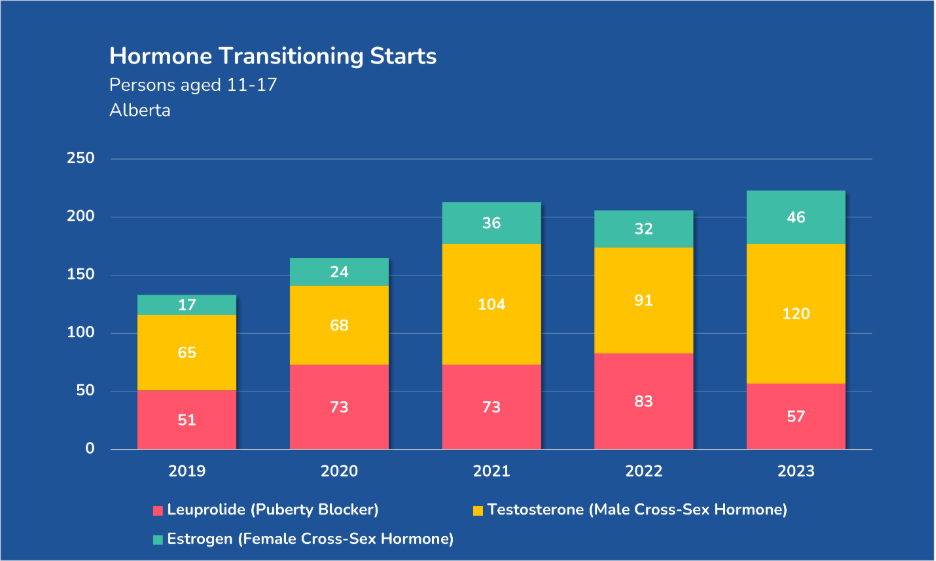
This data shows a growth in the number of adolescents who are hormonally transitioning from 133 in 2019 to 223 in 2023. However, these numbers seem to have plateaued.
Thirty-six percent of hormonal transitions begin with puberty blockers, typically children in their pre-teens showing the first signs of puberty. Sixty-four percent start with cross-sex hormones, with those seeking a masculine transition outnumbering those seeking a feminine transition three to one.
Note that, in addition to the number of children visiting Alberta’s children’s hospitals, there are many more children visiting community gender clinics and family doctors. In other words, far more children are likely seeing medical professionals because of gender dysphoria than just those who end up at these children’s hospitals.
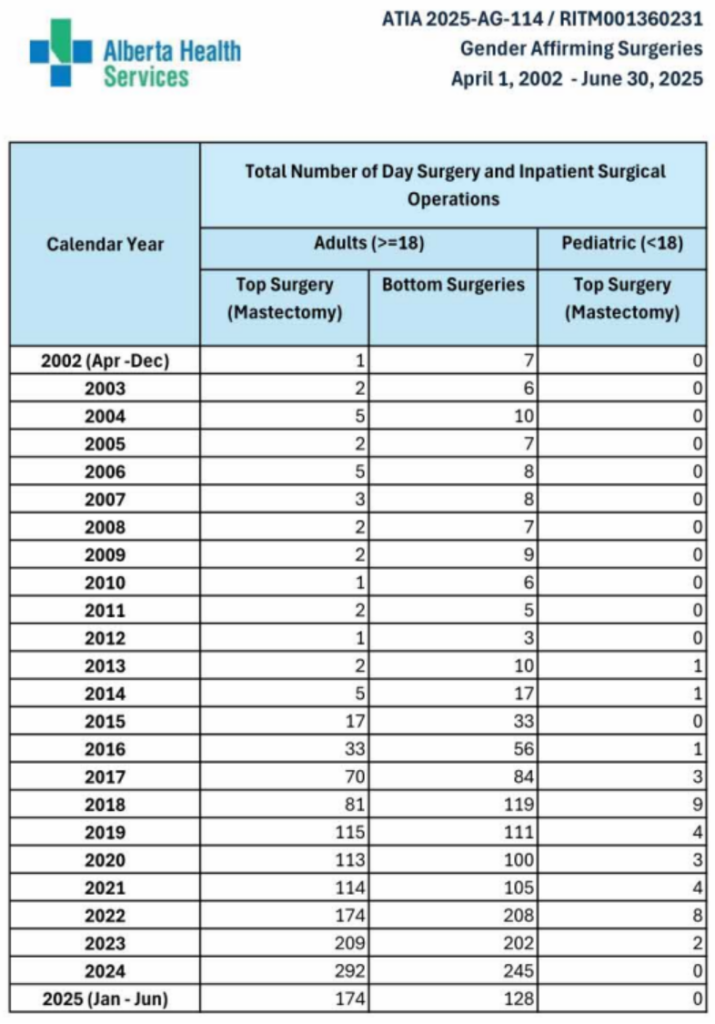
Thankfully, very few of them have received sex-denying surgeries. In another FOI, the government stated that “all lower or bottom surgeries are only available for people 18 years of age or older,” and so there were no recorded instances of a minor receiving these procedures. Thirty-six minors did receive “top surgeries” between 2013 and 2023, however, before the ban on such surgeries went into effect in 2024. And yet, at its height in 2018, one of every ten “gender-affirming” mastectomies was performed on minors.
Conclusion
Alberta may have taken the furthest steps toward banning medical transitioning for minors, but it is still far from that goal. Surgical transitioning for minors is banned. The legislature has enacted a ban on puberty blockers and hormone therapies, but the ban has not fully come into effect. At least two major health care institutions – Alberta Children’s Hospital and Stollery Children’s Hospital – are providing puberty blockers and cross-sex hormones to minors. At least 1,600 minors have sought to medically transition at these two institutions alone in the last five and a half years in Alberta, though only about two hundred youth have newly begun to medically transition in each of those years in the entire province. Relatively few have had any sex-denying surgery.