Under the Microscope: Nova Scotia
Each of Canada’s ten provinces regulates gender medicine differently. This gives each province the ability to adapt to new evidence more quickly and respond to the demands of local citizens better than if health care were centralized with the federal government. But this also means that it is harder to understand all the nuances of each system and to collect data from across the country. Over the coming months, we will do our best to profile the data and policies on medical transitioning for minors in each province.
Policy
Nova Scotia is the only province other than Alberta to have clearly stated age restrictions for medical transitioning in its Gender Affirming Care Policy. Unfortunately, it only applies to surgery. The general rule is that a person must be 18+ to receive gender transition surgery, but 16- and 17-year-olds may request an exemption if they “demonstrate the emotional and cognitive maturity required to provide informed consent.” In other words, there are exceptions to this rule for mature minors.
However, Nova Scotia’s policy sets no hard age limits on hormonal therapies (puberty blockers and cross-sex hormones). Instead, following the World Professional Association for Transgender Health (WPATH) Standards of Care (SoC) 8, Nova Scotia requires that a gender dysphoric adolescent must have begun puberty (i.e. Tanner 2). The policy states that adolescents normally reach this stage of development between the ages of 8-14 years.
Most forms of medical transitioning are publicly funded. Hormonal therapies are covered under the Nova Scotia Pharmacare Programs. “Top” and “bottom” surgeries are also publicly funded through the province’s Medical Services Insurance, though other surgeries (e.g. facial feminization, liposuction, tracheal shave and voice pitch surgery) are not covered.
Providers
The primary provider of pediatric gender medicine is IWK Health, formerly the Izaak Walton Killam Hospital for Children. According to their website, “IWK Health is a proud leader in gender-affirming care. We ensure youth in Nova Scotia access support and treatment based on evidence. Gender-affirming services at IWK Health include assessment for gender incongruence and assisting non-binary and transgender adolescents in understanding and meeting their embodiment and health goals.”
Nova Scotia Health advises that adolescents 17 and younger living within the Halifax Regional Municipality will be served by IWK Health’s Trans Health Team, while those outside the area will be connected with a “trans health clinician” in a local Community Health Centre. Specialized gender youth clinics recently opened in Kentville and Bridgewater, with more such clinics in the works. Eighteen-year-olds (who are still minors in Nova Scotia) can simply go to their family doctor or nurse practitioner or to a “WPATH SoC-trained clinician.”
As for surgeries, while some are performed in Nova Scotia, the province sends most people seeking surgeries to the Centre Métropolitain de Chirurgie-GrS Montréal in Quebec.
Prevalence
As we’ve mentioned before, it is challenging to find data on the number of minors who are medically transitioning. The ideal dataset would reveal the full number of minors currently prescribed puberty blockers or cross-sex hormones for the purpose of a gender transition, plus the number of “gender-affirming” surgeries performed on minors each year. But there are a couple of factors that make such data difficult to collect.
First, so many players are involved in gender medicine – children’s hospitals, gender clinics, and family doctors – that it is hard to collect all the relevant data. Not everyone involved in providing gender medicine reports all of the needed data. And so, the little data available makes up only a few pieces of the puzzle. Second, because all the medications or surgeries prescribed for gender transition are also used to treat other conditions (e.g. precocious puberty, breast or prostate cancer, menopause, or naturally low hormone levels), it is difficult to isolate prescriptions for “gender-affirming care.” For example, it is relatively straightforward to find the number of prescriptions of testosterone through a public drug plan. But that data isn’t very helpful when the reason for prescribing testosterone isn’t listed in the data.
In sum, the government doesn’t publish comprehensive data on medical transitioning anywhere. In most cases, that’s because the government doesn’t have the information. They simply let the system of medical transitioning carry on.
Some data on the number of minors who are medically transitioning in Nova Scotia have been uncovered by various Freedom of Information Requests, mostly filed by Melanie Bennet from Juno News. The FOIs revealed that 21 “top” surgeries (mastectomies) and 9 “bottom” surgeries were approved for minors in the fiscal year 2023-2024 in Nova Scotia and out of province. (In an attempt to maintain privacy, every number that is below 5 is redacted under the code 20(1). Hence, each cell obscured by 20(1) could be read as below 5 but at least 1.)
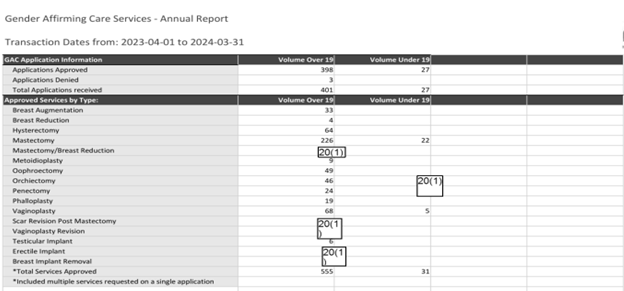
However, only a few of these surgeries were actually performed. No “bottom” surgeries and fewer than five “top” surgeries were performed on Nova Scotians younger than 19 from 2023-2024.

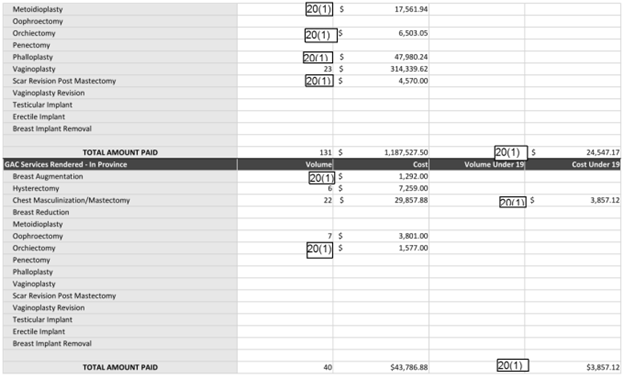
The reason for the difference between the number of surgeries approved and performed is not clear. It is possible that there was enough of a time delay between the approval of a gender surgery and the performance of a gender surgery that the person aged out of the data. For example, an 18-year-old could be approved for a mastectomy, but that mastectomy isn’t performed until she is 19. Alternatively, a young person may initially want surgery and receive approval but then decide they don’t want it.
Unlike most other provinces, Nova Scotia has released some data on the number of minors receiving puberty blockers and cross-sex hormones in recent years. Prescriptions for these hormonal interventions were relatively low from 2019-2023, with no more than 9 minors receiving puberty blockers and 37 receiving cross-sex hormones in a given year. But these numbers exploded in 2024 when 90 received puberty blockers and 195 received cross-sex hormones the following year. That is a 1000% and 696% increase, respectively, in a single year.
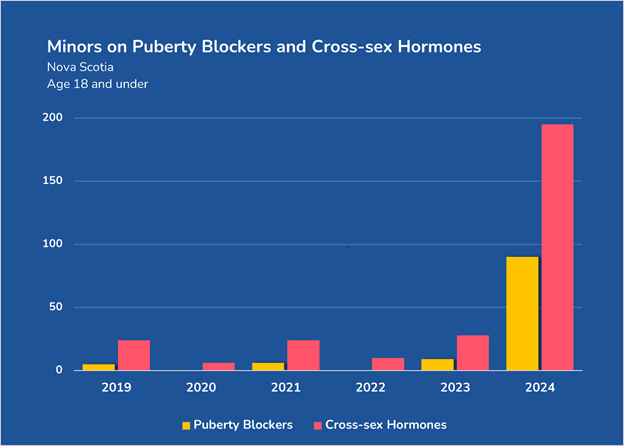
The reason for this spike is unclear. It may be the result of the opening of a new youth gender clinic in Kentville in February of 2024, allowing many minors who wanted hormones but previously couldn’t get them to access them. Or the number of minors actually seeking gender hormones went up drastically. Neither of these seems plausible to account for such a dramatic spike, however. It might simply be due to differences in data reporting, with the majority of minors receiving hormone therapy not being reported in previous years.
Conclusion
As in most other provinces, Nova Scotia liberally permits medical transitioning for minors. There are no hard and fast age restrictions to receive puberty blockers or cross-sex hormones. The province generally restricts “top” and “bottom” surgeries to those eighteen and older, but allows exceptions to this policy for 16- and 17-year-olds. Unlike most other provinces, Nova Scotia has some specific data on the number of minors who are medically transitioning. Ninety kids were prescribed puberty blockers and 285 were prescribed cross-sex hormones in 2024. Twenty-two were approved for “top” surgery and nine for “bottom” surgery in 2023-2024, though fewer than five actually received a mastectomy, and none received genital surgery.