Available in Audio Format:
With nearly 40% of Canada’s population, Ontario likely provides the greatest number of medical transitions to minors in the country. While the Ontario policy and providers of sex-rejecting interventions are publicly available, any specific statistics on the number of children and adolescents who are transitioning are lacking.
Until now.
After describing Ontario’s gender medicine policies and where these interventions are provided, this article gives some insight into the extent of medical transitioning for minors in Canada’s largest province.
Policy
As with most other Canadian provinces, Ontario doesn’t regulate medical transitioning. Sherbourne Health, an organization that provides services “to people who may experience barriers to accessing health care” such as “2SLGBTQ people” runs Rainbow Health Ontario. Rainbow Health Ontario is the province’s leading promoter of medical gender transitioning. As part of their efforts, Rainbow Health Ontario publishes its own 136-page Guidelines for Gender-Affirming Primary Care with Trans and Non-Binary Patientsto help clinicians in their day-to-day practice. However, the document focuses on those who have completed puberty “and does not address considerations for trans and non-binary children or youth who have not completed puberty.”
The Guidelines promote an “informed consent model” for hormonal transitions rather than a traditional “gatekeeper model.” This informed consent model dispenses with any in-depth mental health assessment or referral process, though the Guidelines claim that this does not equal “hormones on demand.” Sherbourne Health claims that “new patients are usually seen for a number of visits prior to the initiation of hormone therapy,” though urgent cases are fast-tracked. A diagnosis of gender dysphoria or gender congruence is recommended prior to hormonal transition.
To be eligible for public funding under OHIP, a physician or nurse practitioner must fill out a Request for Prior Approval for Funding of Sex-Reassignment Surgery to be approved by the Ministry of Health. This form requires that a patient be assessed “by a provider trained in the assessment, diagnosis, and treatment of gender dysphoria in accordance with the World Professional Association for Transgender Health (WPATH) Standards of Care.” This assessment for “chest surgery” requires the diagnosis of persistent gender dysphoria for a mastectomy and a gender dysphoria diagnosis plus 12 months of continuous hormone therapy with no resulting breast enlargement (unless hormones are not recommended) for breast augmentation. For “genital surgery,” the assessment requires a diagnosis of persistent gender dysphoria, 12 continuous months of hormone therapy (unless hormones are not recommended), and 12 continuous months of living in their new gender role.
These are not legal requirements, however. They are funding requirements. It is perfectly legal to perform a sex-denying surgery on a minor who doesn’t have a diagnosis of gender dysphoria, who has never been on cross-sex hormones, or lived in their “new gender role.” Those requirements must only be met if the surgeon or patient wants the government to pay for their surgical transition.
Ontario covers the cost of puberty blockers, cross-sex hormones, and most “top” and “bottom” gender surgeries for minors if the proper forms are submitted. Some chest contouring and breast augmentation procedures are not publicly funded.
Providers
Puberty blockers and cross-sex hormones are relatively easy to access in Ontario. Many primary care providers (i.e. family doctors) now prescribe them to children and adolescents. One study with data collected in 2009-10 found that 67% of trans-identifying people in Ontario who were hormonally transitioning were prescribed these hormones by their family doctor. Rainbow Health Ontario believes that percentage “is almost certainly greater now.”
But if a family doesn’t have a family doctor who is willing to prescribe hormones, many community health clinics offer them. For example, Northern Ontario’s Gender Diversity Clinic, York’s Gender Affirming Health Clinic, Kingston’s Transgender Health Program, Durham’s Gender Care Team, Chatham-Kent’s Youth Gender Diversity Clinic, and Thrive Kids’ Clinic’s Gender-Affirming Pediatric Care program in Toronto all explicitly say on their websites that they prescribe puberty blockers and cross-sex hormones to children and adolescents.
There are also four hospital-based gender clinics in Ontario. SickKids Hospital Gender Clinic in Toronto, “one of the largest transgender youth clinics in Canada,” and CHEO’s Gender Diversity Clinic in Ottawa garner the most attention. But the London Children’s Hospital’s Gender Pathways Service and McMaster Children’s Hospital Adolescent Medicine Clinic provide hormonal transitioning to children as well.
Gender surgeries are primarily performed at the Women’s College Hospital in Toronto and the Ottawa Hospital. The Women’s College Hospital began offering gender surgeries in 2018, claiming to be the “first public hospital-based surgical program in Canada focused on providing safe and timely access to gender affirming surgical care.” It offers most “top” and “bottom” surgeries. The Ottawa Hospital’s gender-affirming surgery clinic opened in 2023, offering not only “top” and “bottom” surgeries but also facial feminization and masculinization surgeries. That hospital claims that “it is the only clinic in Ontario and the second in Canada to offer all three” types of procedures.
Specialty clinics such as Catalyst Surgical and GraceMed are dedicated to exclusively providing gender surgeries, with GraceMed alone claiming to have performed over 2,500 gender surgeries since 1988. Other plastic surgeons and clinics across the province also list “gender-affirming surgeries” among their wider cosmetic offerings.
Prevalence
It is challenging to find data on the number of minors who are medically transitioning in Ontario. The ideal dataset would reveal the full number of minors currently prescribed puberty blockers or cross-sex hormones for the purpose of a gender transition, plus the number of “gender-affirming” top and bottom surgeries performed on minors each year. But there are a couple of factors that make such data difficult to collect.
First, so many players are involved in gender medicine – children’s hospitals, specialized gender clinics, and family doctors. Not everyone involved in providing gender medicine is reporting all the needed data. And so, the little data available is often only a few puzzle pieces of the entire picture. Second, because all the medications or surgeries prescribed for a gender transition are also used to treat other conditions (e.g. precocious puberty, breast or prostate cancer, menopause, or naturally low hormone levels), it is difficult to isolate prescriptions for “gender-affirming care.” For example, it is relatively straightforward to find the number of prescriptions of testosterone through a public drug plan. But that data isn’t very helpful when the reason for prescribing testosterone isn’t listed in the data.
Because of all of this, the government doesn’t publish comprehensive data on medical transitioning anywhere. In most cases, that’s because the government doesn’t have the information. They simply let the system of medical transitioning carry on.
A couple of FOI requests to the government of Ontario confirm this. The government confirmed that they do not comprehensively track the number of minors receiving puberty blockers or cross-sex hormones at community health clinics from family doctors. However, the Ministry of Health began receiving data on the number of children and adolescents served at the four hospital-based gender programs. Due to a lack of reporting, the only total that we can report with certainty is that these hospital-based pediatric gender clinics saw 1,430 children in 2023-24. The Children’s Hospital of Eastern Ontario (CHEO) in Ottawa saw more than half of those patients. And in three of the four comparative years, the number of minors visiting these clinics increased from the previous year.
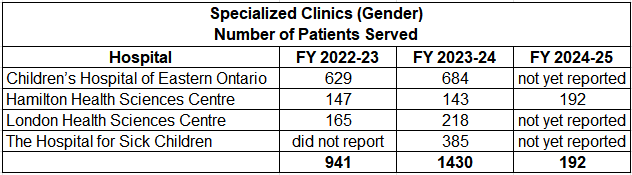
These numbers, however, are just the tip of the iceberg. They do not include the number of children and adolescents seen at community gender clinics or by family doctors. Remember that as far back as 2009-2010, two-thirds of hormonal transitions were prescribed by family doctors, and that figure is likely much higher today. If family doctors still see two-thirds of all children with gender dysphoria and community gender clinics see as many children as the hospital-based clinics, the number of children seeking medical help for gender dysphoria would be approximately 8500 a couple of years ago.
Furthermore, Ontario stated that it does “not track SRS [sex reassignment surgeries] performed in-province.” Ironically, they do track such surgeries performed out-of-province and even out-of-country.
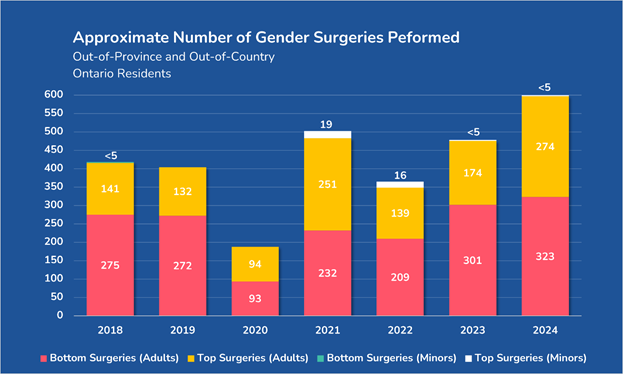
From 2018-2024, Ontario sent almost 3,000 individuals out of the province and even out of the country for gender surgeries. That averages out to about 420 per year. For the sake of context, Ontario sent more residents out of the province for gender surgeries than the province of Alberta performed last year. Now, Ontario doesn’t send patients out of the province for these surgeries because no institution provides them in Ontario. As mentioned above, hospitals and gender surgery clinics provide the full gamut of gender surgeries in the province. Patients were likely sent out of the province and out of the country because there was too much demand for these surgeries for these Ontario hospitals and clinics to handle. Sending patients outside Ontario allowed them to get surgery faster.
The government did not release the locations of where these surgeries occurred, but most out-of-province surgeries likely occurred at GrS Montreal, which is well known for handling gender surgeries for people around Canada.
Relatively few gender surgeries (roughly 40) were performed on minors out-of-province or out-of-country over the last few years. In 2018, fewer than five minors were sent out of the country for a phalloplasty. (Ontario lists numbers between one and four as <5, which makes data less precise but protects individuals’ privacy.) Nineteen minors received mastectomies out of province in 2021, sixteen more in 2022, and fewer than five in both 2023 and 2024.
Many gender ideologues claim that gender surgeries are not performed on minors in Ontario. But the above data demonstrates that minors from Ontario have been operated on out of province, paid for by OHIP. And while there is ironically no data on gender surgeries performed within Ontario (even though we have data on out-of-province surgeries for Ontarians), with no legal or clinical rules against it in Ontario, such surgeries have likely happened here too.
Conclusion
There are no legal restrictions on medical transitioning for minors in Ontario. The non-governmental organization Rainbow Health Ontario provides guidelines for clinicians, but its guidelines don’t address age restrictions. Puberty blockers, cross-sex hormones, and most “top” and “bottom” surgeries are eligible for public funding through OHIP, provided that a person is diagnosed with persistent gender dysphoria. In some cases, a twelve-month waiting period is required as well.
Unfortunately, only some of the data on children who are medically transitioning is available. Over 1,400 children visited hospital-based gender clinics in 2023-24. Many more visited community gender clinics or their family doctor. Approximately 40 minors received mastectomies out-of-province in the last few years, and up to four minors received bottom surgeries out-of-country in 2018. No data is available on the number of gender surgeries performed in the province.