
Available in Audio Format:
Each of Canada’s ten provinces regulates gender medicine differently. This gives each province the ability to adapt to new evidence more quickly and respond to the demands of local citizens better than if health care were centralized with the federal government. But this also means that it is harder to understand all the nuances of each system and to collect data from across the country. Over the coming months, we will do our best to profile the data and policies on medical transitioning for minors in each province.
Prince Edward Island is the setting for a renowned children’s story: Anne of Green Gables. In the classic tale, an imaginative, talkative, and red-haired orphan is adopted by the Cuthberts. Anne initially struggles to fit in and bucks traditional norms. Accidentally dying her hair green doesn’t help. But through growth, love, and self-sacrifice, Anne eventually settles down and gives up her educational dreams to care for her adoptive mother. These themes reflect the values and times of 1908, the date Anne of Green Gables was published.
Many girls have similar struggles about fitting into today’s society. One of those growing struggles is over what it means to be a female or whether it is even possible to define what a woman or a girl is. A girl pushing back against gendered expectations (e.g. perhaps purposely dying her hair green) today might be drawn in by trans influencers, contract gender dysphoria, and pursue a medical transition to find belonging and identity.
Sadly, rather than encouraging a modern Anne to allow time and biology to take their course, Prince Edward Island would be all too willing to help Anne medically transition.
Policy
According to PEI’s Primary Care Toolkit, the Consent to Treatment and Health Care Directives Act allows minors over the age of 16 to consent to sex-denying hormones without parental consent. No minimum ages are required or recommended for puberty suppression or hormone therapy, though states of puberty are mentioned. Puberty suppression is recommended in “the early stages of puberty” and hormone therapy for those “past puberty or well-advanced in puberty.” As with all other provinces, PEI covers the cost of puberty blockers and cross-sex hormones.
Prince Edward Island publicly funds more forms of sex-denying surgeries than any other province. In addition to paying for all forms of genital surgeries as well as both mastectomies and breast augmentations, the province will also pay for procedures that other provinces deem cosmetic or non-medically necessary. This includes facial surgery, hair removal or replacement therapy, voice therapy, and gamete harvesting and preservation.
For the province to cover the cost of these surgeries, physicians or mental health professionals who are trained in “gender-affirming care” (as defined by WPATH’s SOC 8) must assess the patient, recommend surgery, and complete a Gender Confirming Surgery Prior Approval Request Form. This form requires applicants for surgery to affirm that they are at least 18 years old. A physician must also attest to this age requirement for genital surgery further on. This seems to rule out sex-denying surgeries for minors. However, the Primary Care Toolkit notes that “there may be rare exceptions for those who began their transitions at a young age.”
Providers
The government’s Gender-Affirming Health Services page offers two different routes for a medical transition for minors. Minors under the age of 16 are directed to a pediatrician to discuss any medical transition. Those over the age of 16 are encouraged to contact their primary health provider. These pediatricians and family doctors can prescribe sex-denying hormone therapy. Alternatively, these mature minors can visit the Gender Affirming Clinic in Charlottetown, a clinic that is open on the first and third Wednesdays of each month.
Due to the province’s small population, most sex-denying surgeries are not performed on the island. Most are performed at GrS Montreal except for hysterectomies (removal of the uterus) and oophorectomies (removal of the ovaries), which are performed locally.
Prevalence
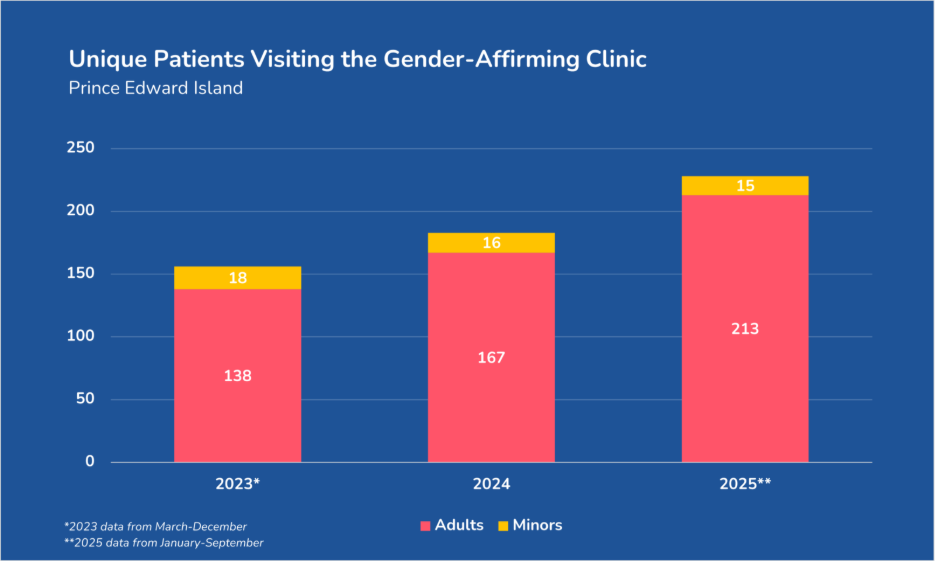
In response to our access to information request, Prince Edward Island did not have any data on the number of people who visited a primary care provider for gender dysphoria or the number of patients currently prescribed puberty blockers or cross-sex hormones. The province was only able to release the number of patient visits and the number of unique patients to the province’s one Gender-Affirming Clinic. This data covered only the last three years and does not capture all of 2023 nor all of 2025.
In each of these (partial) years, the majority of patients were adults. Despite the steady growth in the number of adults visiting the clinic, the number of minors has remained relatively stable over the past three years. At least eighteen minors visited the Gender-Affirming Clinic in the last 10 months of 2023, although a couple more may have dropped in January and February that year. Sixteen visited in 2024. Fifteen visited through the first nine months of 2025, but by the end of the year, that total will likely be a few visitors higher.
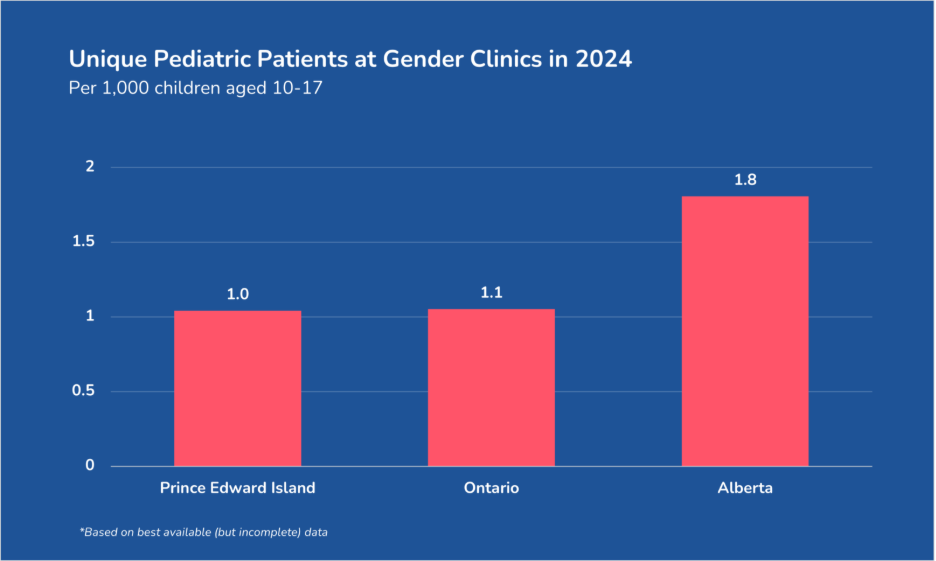
These numbers may be small, but that is because Prince Edward Island has a small population of around 182,000. (For comparison, the entire population of the island is comparable to the mid-sized cities of Sherbrook, Oshawa, or Abbotsford.) Thus far in this series, we have data on the number of unique pediatric visitors to the Gender-Affirming Clinic in Prince Edward Island, the hospital-based gender clinics in Ontario, and the hospital-based gender clinics in Alberta. If we compare the number of children and adolescents who visited these with the number of children and adolescents in each of these provinces, the rates of minors seeking help with their gender dysphoria are comparable. In Prince Edward Island, there are 1.0 pediatric gender clinic visits per 1,000 children aged 10-17. In Ontario, that rate was 1.1. In Alberta, it was 1.8. While this data is incomplete (e.g. it does not take into account community gender clinics in Ontario or Alberta), this gives us some idea of the rate at which children and adolescents are seeking help with gender dysphoria.
The province reports that fewer than five sex-denying procedures have been performed in the province in the last 25 years. Given that all other surgeries are performed out of province, these surgeries were likely hysterectomies and oophorectomies. All of these surgeries were performed on adults. No sex-denying surgeries have been performed in minors in PEI.
Conclusion
Despite its small size and population, Prince Edward Island is not immune to the promotion of medical transitioning. It fully funds more types of sex-denying procedures than any province in the country. Although gender surgeries are limited to adults, there are no age restrictions on hormonal interventions. Most children suffering from gender dysphoria are referred to pediatricians or family doctors, though there is one dedicated gender clinic in Charlottetown. Forty-nine minors have visited this clinic in the last three years, but the number of minors who have been treated for gender dysphoria by family doctors is unknown. The number of children and adolescents who are on puberty blockers and cross-sex hormones is also unknown. Thankfully, there is no record of any underage Prince Edward Islander ever receiving a sex-denying surgery.