
Available in Audio Format:
New Brunswick is the last stop on our tour of the Atlantic provinces’ gender medicine programs. Although these provinces aren’t known to be bastions of progressive politics (or medicine), Nova Scotia, Prince Edward Island, and Newfoundland and Labrador have all fully embraced the “gender-affirming” model of care. Nova Scotia has so bought into this gender ideology that it is one of the few provinces to confirm it has performed sex-denying mastectomies on minors. The province even green lights sex-denying genital surgeries for minors.
Is New Brunswick any better than its Atlantic peers on limiting medical gender transitioning for minors?
Sadly not.
Policy
New Brunswick is the only province in Atlantic Canada without a specialized gender clinic. Pediatric gender medicine is largely provided by the Horizon Health Network and Vitalité Health Network. These networks employ “health care professionals with specialized training in developmental processes, puberty and physical development, evolving identity exploration, legal and social transition challenges, parental and caregiver involvement, and the impact of peer, school, and community environments” to help minors transition. Alternatively, gender dysphoric children can see a pediatrician or a specialized mental health professional.
Hormone therapy is usually provided through primary care providers, pediatricians, and endocrinologists. Some of these health care practitioners may require a hormone readiness assessment letter from a medical health professional. These referral letters will generally contain any relevant diagnoses, any treatment history, and a statement of informed consent from the patient.
Horizon Health Network provides a comprehensive list of health care providers across the province involved in gender medicine. Any hormone readiness letter provided by a member of the Horizon Health Network is covered by the provincial Medicare plan, but readiness letters provided by health care professionals outside the Network typically must be paid for out of pocket.
While the government webpage on “gender-affirming care” states that their Medicare program does not cover prescription medication (such as puberty blockers and cross-sex hormones), their drug insurance plan covers many medications. New Brunswick’s Drug Plan Formulary does include the most common forms of puberty blockers and cross-sex hormones, and so the cost of most drugs used in a gender transition are paid for by the province.
To get a gender surgery in New Brunswick, a patient needs two documents: a completed Medicare Prior Approval Form and at least one referral to a surgeon. For “top surgery”, one referral letter is sufficient. For “bottom surgery”, two referral letters are required. These documents must be signed by a physician, nurse practitioner, or mental health provider who is trained in gender medicine.
The Medicare Prior Approval Form requires that the patient be at least 16 for a mastectomy and 18 for any other surgery. These age thresholds are not legislated but established by regulation by the Ministry of Health or adopted by the provincial college of surgeons.
These ages, however, are lower than the age of majority. Since the age of majority in New Brunswick is 19, this surgical requestion form explicitly allows removing the healthy breasts and reproductive organs of minors.
The Form also requires a health care professional to attest that the patient has the following:
- Persistent, well-documented gender dysphoria diagnosis
- Capacity to make a fully informed decision and to consent for treatment
- Understands the procedure(s)
- Understands associated risk(s) and complications
- Understands the effect of gender-affirming treatment on reproduction
- Reasonably well controlled medical or mental health concerns, if they are present
- Considered the role of social transition
- An aftercare / follow-up plan
For breast augmentation and genital surgery, 6 continuous months of hormone therapy is required “before the patient undergoes irreversible surgical intervention” unless patient does not wish to undertake hormone therapy.
New Brunswick covers the costs of all top and bottom surgeries, except breast construction/augmentation, out of the public purse. However, New Brunswick only performs mastectomies, hysterectomies, and orchiectomies – procedures that cut out breasts, uteruses, and testes – within the province. The remaining genital surgeries are performed by GRS Montreal.
Prevalence
Let Kids Be filed an access to information request for any data related to gender surgeries, hormonal transitions, and visits to specialized gender clinics by minors in New Brunswick. The government claims to have no data on the number of hormonal gender transitions or gender clinic visits. Puberty blockers and cross-sex hormones are used to treat many different conditions, and the government of New Brunswick says they do not have any data on what underlying condition these drugs were prescribed to treat.
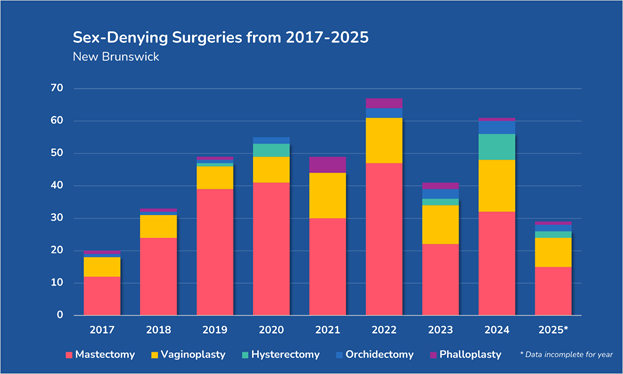
But the government did release data on sex-denying surgeries. The province found no records of any gender surgeries prior to 2015. Their records show two phalloplasties performed in 2016 (presumably in GRS Montreal). In 2017, the province began facilitating gender surgeries in earnest, though no surgeries were reported in New Brunswick hospitals that year. Presumably, all gender surgeries on New Brunswickers were performed in Quebec and Nova Scotia that year.
In 2018, New Brunswick began providing some gender surgeries (e.g. mastectomies, hysterectomies, and orchidectomies) in the province, while more complex procedures continued to be performed at GRS Montreal.
The number of gender surgeries increased quickly prior to the COVID pandemic but has fluctuated wildly since then. As we have seen in other jurisdictions, mastectomies are the most common form of gender surgeries by a wide margin, comprising 65% of all gender surgeries. Vaginoplasties were the second most common procedure, accounting for 23% of all procedures over these years.
Unlike other provinces, New Brunswick released some very interesting information: the age of the patient in each surgery. While other provinces have only given data on the number of surgeries performed on patients in big buckets (e.g. above vs below the age of majority), New Brunswick released the precise age of each patient at the time of surgery. Here is a histogram of the frequency of each type of gender surgery by patient age.
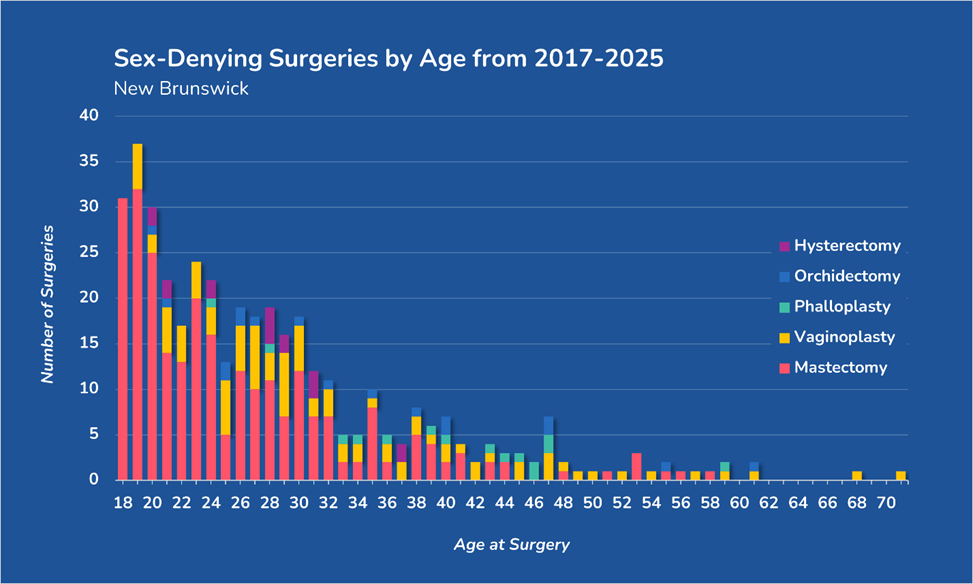
What is most noticeable in this graph is that the younger the patient, the more common surgery is. Sex-denying surgeries are most common at age 19, the age of majority in New Brunswick. Thirty-two mastectomies and five vaginoplasties have been performed on nineteen-year-olds in the past eight years.
By age twenty, young adults are starting to get hysterectomies and orchidectomies. As these surgeries remove a person’s uterus and testes, these procedures sterilize young adults for the rest of their lives.
Roughly half (48%) of all gender surgeries in New Brunswick are performed on persons at or under age 25, the age at which many scientists believe that the brain is fully developed. Almost two hundred New Brunswickers have had parts of their body amputated before their brain is fully mature.
There are also age differences in each type of sex-denying surgery. Gender dysphoric women remove female organs early in their gender transition, with the average of a mastectomy being 26 and 27 for a hysterectomy. But these women on average wait until age 41 for a phalloplasty, the attempted creation of a penis. Gender dysphoric men, on the other hand, wait on average until age 32 to get a vaginoplasty but only wait a few years longer to have their testes removed (average age of 35 for an orchidectomy).
Based on this data, gender dysphoric women are quick to get rid of their feminine organs and slow to try to ask for a penis in New Brunswick. Gender dysphoric men are the reverse. They typically ask for a vagina first and only later opt to have their male organs removed.
Conclusion
New Brunswick is a fairly typical province in Canada in its practice of gender medicine. Although it has no specialized gender clinic for either minors or adults, New Brunswick residents can still access puberty blockers and cross-sex hormones at public expense from primary care providers, pediatricians, and endocrinologists without age restriction. The health care system does limit sex-denying top surgeries to those 16 and older and bottom surgeries to those 18 and older, although this is a funding (rather than a legal) requirement.
Like most other provinces, New Brunswick was unable to provide any data on the number of children and adolescents who are hormonally transitioning. However, it provides some very unique data on the precise ages of those who received a gender surgery. These surgeries are most commonly provided to young people, with 19, 18, and 20 being the most common ages for surgery. No minors in New Brunswick received genital surgeries, but 31 received mastectomies between 2017 and 2025.
And so, just like the other Atlantic provinces, New Brunswick needs a radical policy shift to let kids be.