
As we approach the end of our Under the Microscope series, we’re going to turn to la belle province of Quebec.
Policy
As with all other provinces except Alberta, kids can access a medical gender transition in Quebec relatively easily at no out-of-pocket cost.
Minors can get puberty blockers and cross-sex hormones in a few different ways in Quebec. Some family doctors require a referral letter from a mental health professional before prescribing hormones, while others will assess patients themselves through an informed consent approach. This approach does not actually diagnose a minor’s gender dysphoria, but only determines whether the minor has the capacity to make an informed decision about a medical transition. In fact, one guide says that “it is rare for mental health professionals to diagnose gender dysphoria in the context of a medical transition.”
Endocrinologists can also prescribe these sex-denying hormones. Children and adolescents usually can’t just book an appointment with an endocrinologist. They need a referral from a family doctor and/or another medical professional.
Transitionner, a website dedicated to helping gender-confused people navigate Quebec’s health care system, says that cross-sex hormones can be initiated from age 14 and onwards with parental consent. They mention no minimum age restrictions for puberty blockers. Regarding sex-denying surgery, GrS Montreal states that adolescents can get a mastectomy starting at age 16 and bottom surgery starting at age 18, claiming that this is the recommendation of the most recent WPATH Standards of Care.
They also outline the requirements needed to get a sex-denying surgery:
- Patient completes a health status form
- Doctor completes the health status form
- Surgeon receives referral letter(s) from a psychologist, sexologist and/or social worker
- Patient has a pre-operative appointment with the surgeon
- Government approves surgery funding request
Some public hospitals and private clinics provide these sex-denying surgeries, depending on the type of surgery. Most gender surgeries, however, are performed at GrS Montreal, the most prolific provider of sex-denying surgeries in the country. According to their website, they have performed “more than 10,000 gender-affirming surgeries over the past 12 years.” (GrS Montreal first published this statistic on their website in late 2023, so they likely have done several thousand more by now.)
Unfortunately, the province pays for most forms of medical transitioning. Puberty blockers and cross-sex hormones are almost always covered through Quebec’s public drug coverage plan. All genital surgeries performed at GrS Montreal are covered, as are mastectomies.
Prevalence
Let Kids Be filed an access to information request on any data related to gender surgeries, hormonal transitions, and visits to specialized gender clinics in Quebec. The government responded that they have no data on hormonal transitions or the number of visits to specialized gender clinics. However, the province did release data on the number of gender surgeries performed in the province over the last fifteen years.
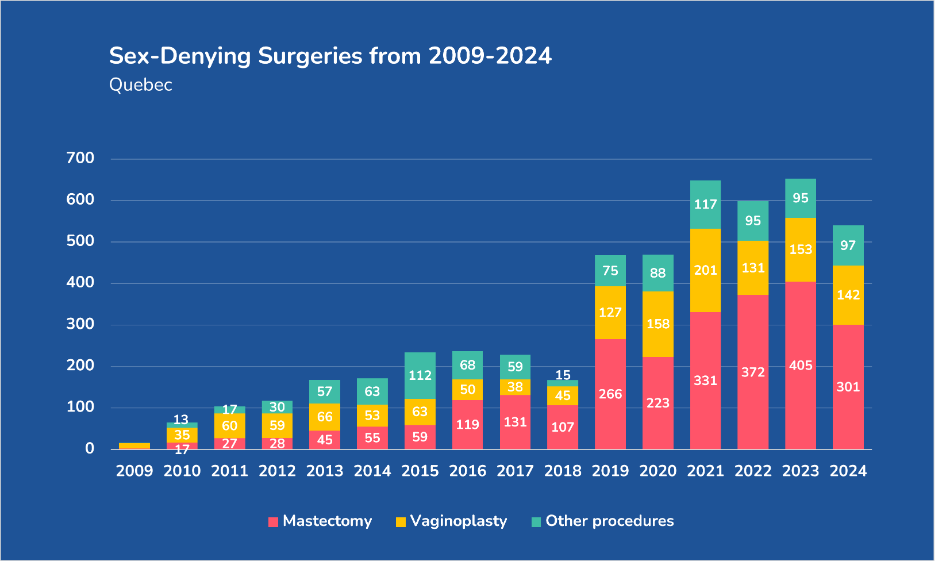
Although this data covers patients of all ages – both adults and minors – it demonstrates the growth in gender surgeries in Quebec. In 2009, there were only 16 sex-denying surgeries: 13 vaginoplasties, two mastectomies, and one other surgery. The number of surgeries steadily grew to 237 in 2016, declined to 167 in 2018, and then exploded to over five or six hundred in each of the last few years.
If we add up all the sex-denying surgeries across all hospitals reported in this access to information request, they total just under 5000. That is only half of the 10,000 surgeries that GrS Montreal alone claims to have performed in the last 12 years. The difference is likely due to surgeries performed on interprovincial or international patients. This surgical centre has accepted patients from around Canada – and indeed around the world – for transgender surgeries for years.
Intriguingly, Quebec had already released the number of sex-denying surgeries performed on minors in a previous access to information request available on the government’s access to information database.
Table 1: Number of applications and accepted applications for sex-denying surgeries for minors in Quebec
| Year | Applications submitted | Applications accepted |
| 2019 | 10 | 9 |
| 2020 | N/A | N/A |
| 2021 | 6 | ≤5 |
| 2022 | ≤5 | ≤5 |
| 2023 | 11 | 11 |
| 2024 | 6 | ≤5 |
| 2025 | ≤5 | ≤5 in evaluation |
This data reveals that gender surgeries for minors are performed in la belle province, though the data does not break down whether these are top or bottom surgeries. From 2019-2025, up to 43 minors requested a sex-denying surgery. Up to 40 requests were accepted, though there is no indication whether these surgeries were actually performed prior to the age of majority.
Sadly, the approval rate for gender surgery for a minor in Quebec appears to be high. The data suppresses small numbers to maintain privacy, so we can’t calculate exactly what percentage of applications were approved. Based on this data, the range could stretch from 56% to 93% of cases approved. Only three rejections show up in the data: one in 2019, another in 2021, and another in 2024.
Conclusion
The practice of medical gender transitioning for minors is sadly alive and well in Quebec. The province is home to the most prolific sex-denying surgical centre – GrS Montreal – in Canada.
There is no law regulating the practice in the province. Puberty blockers may be administered at any age, though there does seem to be a convention that cross-sex hormones should be initiated at age 14, top surgery at 16, and genital surgery at 18. All of these drugs and most surgeries are paid for out of the public purse.
The province has no data on the number of children and adolescents who are medically transitioning, although up to 43 requested – and up to 40 were approved for – a sex-denying surgery.
As with most other Canadian provinces, Quebec desperately needs to ban medical gender transitioning for minors.