
In 2023, Saskatchewan passed a parental bill of rights through the legislature. One of the most controversial rights in the legislation was over students’ preferred pronouns. For youth under the age of 16, the law requires schools to obtain parents’ consent before using new gendered pronouns or names. Although it drew the ire of the opposition and gender ideologues, the government even invoked the notwithstanding clause to ensure that judges could not invalidate the law.
This move required courage and resolve. We commend Saskatchewan for countering gender ideology in this manner. But has the province demonstrated any determination to protect children from medical gender transitioning?
Sadly not.
Policy
Like every other province, Saskatchewan covers the cost of puberty blockers and cross-sex hormones. If a person resides in Saskatchewan and has a Saskatchewan health card, the government generally covers the cost of these drugs.
Saskatchewan was the most hesitant of Canada’s provinces to fund sex-denying surgeries, but that isn’t saying much. It funds mastectomies and all genital surgeries. However, Saskatchewan does not pay for breast augmentation, chest contouring, facial surgery, tracheal surgery, or body contouring.
The procedures that Saskatchewan actually provides are a different story. The provincial health care system performs mastectomies (breast removals), breast augmentation, chest contouring, hysterectomies (uterus removal), oophorectomies (ovary removal), and orchiectomies (testicle removal).
Saskatchewan sends residents to GrS Montréal for any metoidioplasties and phalloplasties (surgeries to construct a simulacrum of a penis), vaginoplasties (attempts to create a vagina), and vulvoplasties (attempts to create vulva). In essence, Saskatchewan’s surgeons have the capability to cut away healthy genitals, but not to try to construct new ones.
To get a surgery in Saskatchewan, all one needs is a referral from a primary care provider.
Getting a surgery out of province is more complicated. First, a primary care provider must refer a patient to a specialist practicing in a relevant field in Saskatchewan. That specialist must write a letter to the ministry pitching the case for surgery. The Ministry of Health’s medical consultant will then assess whether the case merits public funding. If funding is granted, an applicant must still meet any requirements for surgery set by the surgeon at GrS Montréal.
Providers
Most providers of gender medicine are family doctors. TransSask, a pro-transgender non-profit, provides two “trans health navigators” to help people “those seeking gender-affirming healthcare, including hormone therapy, surgery referrals, finding an affirming doctor, and accompaniment to appointments,” but these navigators do not provide medical services themselves.
Unlike larger provinces, Saskatchewan does not have any community clinics or hospital-based programs that specialize in gender medicine. However, the Saskatoon Community Clinic provides “gender affirming care, including puberty suppression for youth.” Because it does not accept self-referrals, would-be patients must be referred by a primary care provider. The clinic advises that it generally provides a gender-affirming care appointment once every 3 months for the first year and once every 6-12 months thereafter.
Prevalence
Let Kids Be filed an access to information request on any data related to gender surgeries, hormonal transitions, and visits to specialized gender clinics by minors in Saskatchewan. The government responded that they have no data on hormonal transitions or gender clinic visits.
This dearth of data demonstrates that this isn’t even an issue on the government’s radar. A growing number of countries around the world are concerned with the ramifications of prescribing puberty blockers and cross-sex hormones to minors. This includes all of Canada’s most comparable peers: the United Kingdom, the United States, Australia, and New Zealand. But Saskatchewan has refused to acknowledge that there is any problem with stunting the sexual development of children or assisting them to develop in the opposite way that their bodies intended them to develop. And without recognizing any problem, the government hasn’t bothered to collect data on pediatric medical transitioning rates.
But the government was able to release some data on sex-denying surgeries over the past six years. As usual, counts less than five are redacted to preserve patient privacy.
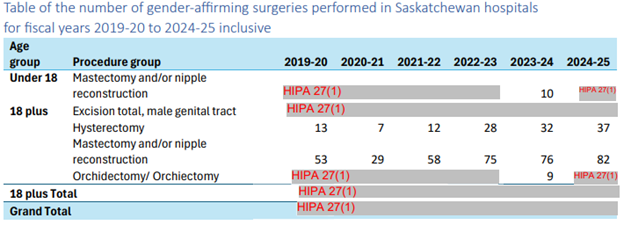
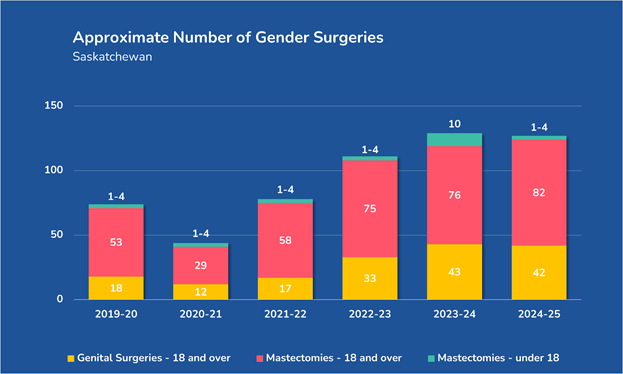
This data confirmed that many of the more complicated sex-denying surgeries are not available within Saskatchewan, but some surgeries are performed in the province. The province performed 373 mastectomies (the removal of breasts), 127 hysterectomies (the removal of the uterus), at least 14 orchidectomies (the removal of testicles), and at least 6 removals of the male genital tract on adults from 2019 to 2024.
As an aside, this date confirms yet again a gender skew. The vast majority of these surgeries – performed on both minors and adults – are attempts by women and girls to become more masculine. Saskatchewan performed at least 388 breast removals over six years. The number of breast augmentations? Zero. Similarly, at least 86% of all bottom surgeries targeted the reproductive organs of women. Some of these discrepancies may stem from Saskatchewan not funding the full gamut of gender surgeries. But, if those who identify as transgender or non-binary need these procedures as much as gender ideologues claim, surely some would have paid the cost. None show up in the data.
Sadly, although no genital surgeries were recorded for minors, at least 15 minors received mastectomies. Ten gender dysphoric adolescents lost their breasts in 2023, and at least one (but fewer than five) received a mastectomy in each of the remaining years from 2019 to 2025.
Conclusion
Despite being willing to tackle gender ideology in schools, Saskatchewan has been unwilling to address gender-ideology-driven medicine in doctors’ offices and hospitals. The province funds puberty blockers and cross-sex hormones, which are prescribed to gender dysphoric children by their family doctors. The province also pays for most sex-denying surgeries, sending patients to Quebec to receive the most complicated procedures.
Saskatchewan is the third province thus far in Canada to confirm that it provides gender surgeries for minors within its borders. Both Alberta and Nova Scotia performed “gender-affirming” mastectomies on minors in their hospitals. Ontario revealed that it sent minors out of province or out of the country for sex-denying surgeries, but did not confirm whether they performed them in-province (though they likely do). At least 15 minors received mastectomies in Saskatchewan since 2019.
As the birthplace of publicly funded health care in Canada, it is tragic to see the public health care system transition away from providing true medical care that preserves bodily integrity to promote health. Instead, Saskatchewan’s medical system is all too willing to provide gender transitions for minors.