
Available in Audio Format:
For 16 of the last 23 years, the NDP has governed Manitoba in accordance with its progressive or left-of-centre ideology. Progressive parties are usually more supportive of gender ideology and medical gender transitioning than their conservative counterparts.
Is this apparent in Manitoba’s policies, providers, and prevalence of medical transitioning for minors?
Yes. Manitoba liberally provides medical gender transitioning for minors. Though governed the longest by progressive governments in this century, Manitoba’s approach to gender medicine is similar to that of other Canadian provinces, with the recent exception of Alberta.
Policy
One of the main purveyors of pediatric gender medicine in Manitoba is the Gender Diversity and Affirming Action for Youth (GDAAY) clinic next to the Winnipeg Children’s Hospital. The clinic has a multidisciplinary team that includes a pediatric endocrinologist, an adolescent medicine physician, a physician assistant, and a psychologist. The clinic, which opened in 2011, primarily serves youth 14 and younger.
Prospective patients of the GDAAY clinic must be referred by a health care professional such as a family doctor. GDAAY’s referral form includes a question about whether it is “safe” to send correspondence to the prospective patient’s home address or home telephone number. Another question asks if there is anyone in the youth’s family that “cannot know about the youth’s gender identity.” This wording implies that the clinic views parents and family members as potential enemies of their child rather than as the most important guides in their lives.
The clinic’s website says that it often takes more than one appointment to be prescribed puberty blockers and cross-sex hormones. A physical examination and blood work may also be required before they will proceed with a hormonal transition. GDAAY also notes that, while gender surgeries are “often” performed in adulthood, adolescents aged 16 and older may get “top surgery” and adolescents aged 18 and older may receive “bottom surgeries.” The age of majority in Manitoba is 18 years old.
Another provider of a medical transition is the Trans Health Klinic, which serves adolescents aged 15 and older. In their description of their care process, they mention that hormones are dispensed on the second appointment with a medical professional. It is troubling that there seems to be no waiting period to allow other issues (e.g. mental health challenges or physical co-morbidities) to be addressed.
Psychologists at the Trans Health Clinic advertise that they write letters of recommendation for gender surgery after completing a 10–16-page assessment of gender dysphoric adolescents. This assessment for surgical readiness is based on the activist WPATH Standards of Care 8 guidelines. However, the clinic explicitly says that mental health challenges do not preclude sex-denying surgeries. The clinic does not appear to require these challenges to be explored or addressed prior to surgery.
Currently, Manitoba Health requires a diagnosis of gender dysphoria to fund any gender-related surgeries. For top surgery, the province requires one letter of recommendations (from either a health care provider or a psychologist). For bottom surgery, two recommendations are required (one from a health care provider and one from a psychologist).
Of these surgeries, Manitoba funds top surgeries (e.g. breast augmentation, chest reductions, and mastectomies) if the proper assessment form is used. The Manitoba health care system provides orchiectomies, hysterectomies, and oophorectomies within the province. Penectomies, vulvoplasties, vaginoplasties, metoidioplasties, and phalloplasties are all performed at the Centre de Chirurgie in Montreal. All these bottom surgeries are publicly funded if the assessment form is satisfactorily completed and the patient has been on cross-sex hormones for at least six months.
Prevalence
Let Kids Be filed an access to information request on any data related to gender surgeries, hormonal transitions, and visits to specialized gender clinics by minors in Manitoba. The government responded that they have no data on hormonal transitions and required an excessively high fee to collect and release surgical data. However, it did release data on the number of patient visits to the GDAAY clinic, one of the two main gender clinics in the province.
That data is summarized in the chart below. Unfortunately, the released data does not elaborate on what the abbreviations in this chart mean. Presumably, “endo” stands for endocrinologists, “SW” stands for social workers, and “PA” for physician assistants. All three are staff positions mentioned as part of GDAAY’s interdisciplinary team. It is unclear what “MH” stands for (it could be Manitoba Health, mental health, or something else).
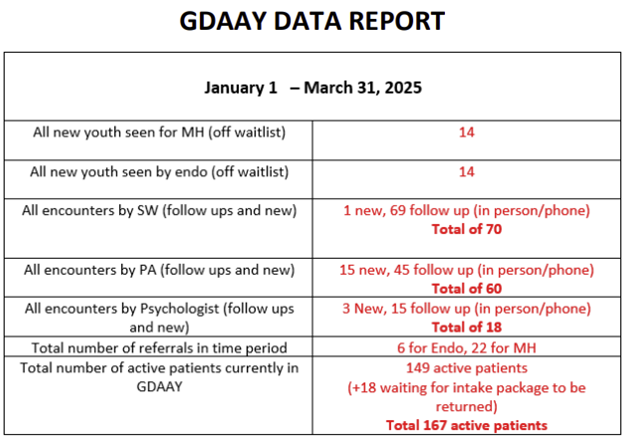
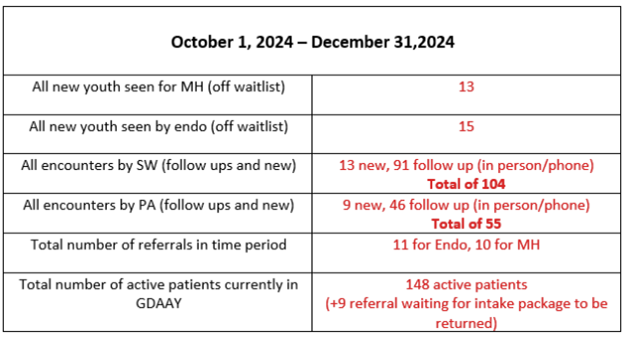
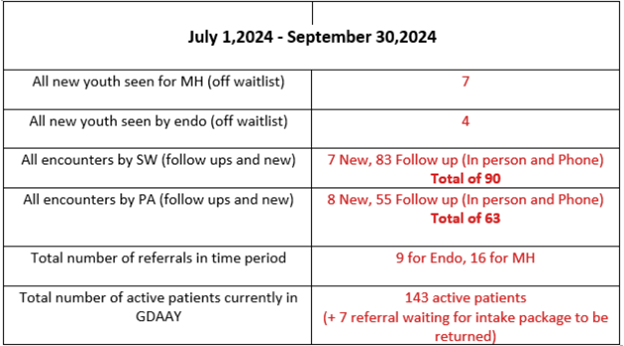
A few things stand out from this data. First, GDAAY had a slightly increasing number of active patients per quarter: from 143 in Q3 of 2024, to 148 in Q4 of 2024, to 149 in Q1 of 2025.
Second, the number of new patients also increased each quarter over the same period, from 7 to 13 to 14. That means GDAAY was on track to see 40-50 new patients in 2025. That is slightly down from the 75 new patients per year reported in 2023.
Third, a fluctuating number of youth were newly referred to or seen by an endocrinologist, with anywhere between 4 and 15 in each quarter. We do not know how many of the new patients seen by GDAAY endocrinologists were prescribed puberty blockers or cross-sex hormones. But, there would be no point in meeting with an endocrinologist if the youth did not desire a hormonal transition.
Fourth, however you look at the data, it seems that nearly all of the new youth seen at the GDAAY clinic proceeded towards hormonal transitioning. Between the three quarters, the clinic had 30 new “MH” patients, 35 new encounters with social workers, and 32 new encounters with physicians’ assistants. Thirty-three youth saw an endocrinologist. These are all likely the same patients using the services of various types of staff, and different stages of the intake process that these patients visited these professionals, likely account for the slight variation in the number of new visits here.
It clearly is not just a small fraction of gender dysphoric children visiting the clinic who are considering medical transitioning. It appears most meet with an endocrinologist to talk about it.
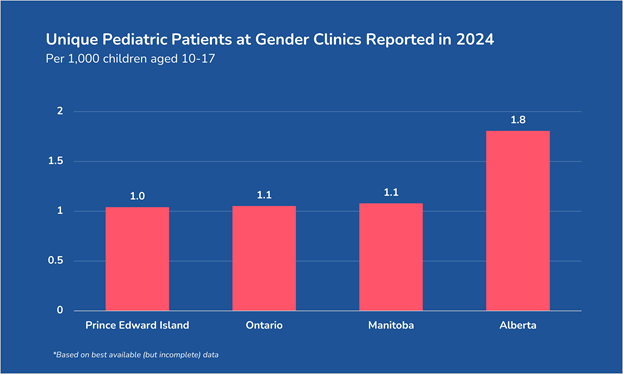
Fifth, the number of active patients seen by the GDAAY clinic translates into a comparable rate of per capita medical gender transitioning for other provinces for which data is available. We caution against making definitive comparisons between these provinces, as each has released varying amounts of data. (For example, Manitoba only reported pediatric gender clinic data for one of its two major gender clinics and for only part of the year.) But the incomplete data released by each province thus far shows a similar rate of children and adolescents visiting gender clinics.
Conclusion
Manitoba follows the crowd of Canadian provinces in pediatric gender medicine. Two clinics, GDAAY and Trans Health Klinic, are responsible for most medical transitioning for minors. Cross-sex hormones and puberty blockers are generally prescribed free of charge to children and adolescents of any age. Adolescents may obtain “top surgery” at age 16 and genital surgery at 18, with the provincial government paying for the procedure.
The province did not disclose the number of minors on puberty blockers or cross-sex hormones or who received a gender surgery. But, as we saw, it did release data on visits to the GDAAY clinic over three recent quarters.
GDAAY saw over 30 new patients and over 140 total patients in three quarters at the end of 2024 and beginning of 2025. Almost all of these new patients appear to be pursuing hormone treatments. The number of gender clinic visits is comparable to the rate of visits in other provinces based on the limited data revealed to Let Kids Be through freedom of information requests.
Liberally permitting children and teens to take puberty blockers and cross-sex hormones without any age restrictions, despite the dearth of high-quality evidence, is a travesty. Like almost every other province, Manitoba needs to put the brakes on medical gender transitioning for minors and let kids be.